Surging Global Population To Fuel Agricultural Drone Use on Farmlands
The United Nations forecasts that the world population will grow from 7.7 billion in 2019 to 10.9 billion by 2099. In addition, Instituto Nacional de Estudios Demográficos estimates that India, China, the U.S., Indonesia, Brazil, Japan, the U.K., and France will be home to 1,639,176,000, 1,402,405,000, 379,419,000, 330,905,000, 228,980,000, 105,804,000, 74,082,000, and 67,587,000 people, respectively, by 2050.
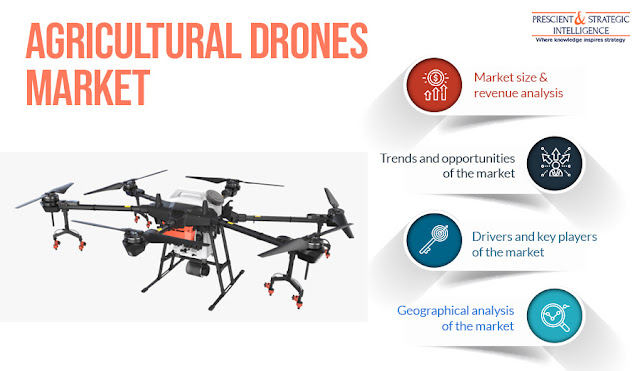
The farming community is increasingly using agricultural drones for crop spraying to monitor distant locations of farmlands on a real-time basis. Moreover, the usage of such unmanned aerial vehicles (UAVs) assists farmers in ensuring uniform spraying of an adequate quantity of liquid on crops.
The expanding population base will create an enormous requirement for farm products in the foreseeable future. Thus, the surging need to increase farm productivity will help the agricultural drones market demonstrate an exceptional CAGR of 25.0% between 2019 and 2024. According to P&S Intelligence, the market revenue stood at $1.5 billion in 2018 and it will reach $6.2 billion by 2024.
The farming community is increasingly using agricultural drones for crop spraying to monitor distant locations of farmlands on a real-time basis. Moreover, the usage of such unmanned aerial vehicles (UAVs) assists farmers in ensuring uniform spraying of an adequate quantity of liquid on crops.
Currently, the agrarian community can use fixed-wing, multi-rotor, and single-rotor agricultural drones on their farmlands for aerial planting, crop spraying, crop monitoring, health assessment, irrigation, and soil and field analysis.
In the last few years, farmers preferred multi-rotor agricultural drones over other variants due to their affordability and easy-to-use mechanism. These drones are viable for crop spraying, crop management, and health assessment. Farmers around the world can opt for large, micro, medium, or small-sized multi-rotor agricultural drones as per their requirements.


Comments
Post a Comment